P2P Lending Comparison
Mintos vs Capitalia: Which Fits Your Portfolio in 2026?
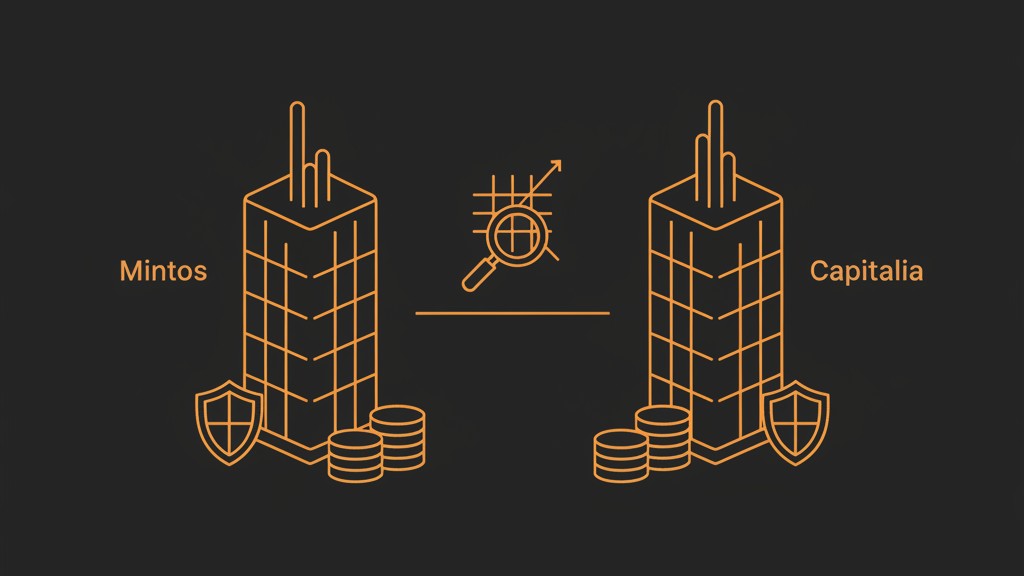
Mintos brings MiFID II marketplace scale and 700,000+ investors; Capitalia offers nearly two decades of Baltic SME lending heritage. This comparison examines track record, buyback policies, secondary market access and target returns using verified facts from both platforms.
Not investment advice. mintos-reviews.com is an editorial review site and does not hold client money or provide personal investment recommendations. Both Mintos and Capitalia carry a risk of partial or total loss of invested capital. Verify all terms directly with each platform before investing.
Side-by-Side Comparison
| Feature | Mintos | Capitalia |
|---|---|---|
| Headquarters | Riga, Latvia | Riga, Latvia |
| Operating since | 2015 | 2007 |
| Regulator / licence | Latvijas Banka, MiFID II | Latvijas Banka, ECSP |
| Loan types | Consumer, business, car, bonds, real estate | SME, factoring, venture debt, crypto |
| Buyback guarantee | Partial (originator-dependent) | No |
| Secondary market | Yes | Yes |
| Minimum investment | EUR 50 | EUR 200 |
| Target return | 9-11% | 10-12% |
Where Mintos Wins
- MiFID II licence. Mintos holds a MiFID II investment-firm licence from Latvijas Banka, a higher regulatory tier than Capitalia's ECSP registration.
- Lower barrier to entry. Mintos requires EUR 50 minimum vs Capitalia's EUR 200, making diversification across smaller positions easier.
- Larger investor base and scale. Mintos has 700,000+ investors and EUR 12.4 billion+ cumulative volume, dwarfing Capitalia's reach.
- Originator-dependent buyback. While not universal, some Mintos originators offer buyback guarantees; Capitalia has no buyback at all.
- Broader loan-type menu. Mintos covers consumer, business, car, bonds and real estate, while Capitalia focuses on SME, factoring, venture debt and crypto.
Where Capitalia Wins
- Longer operating history. Capitalia has been active since 2007, nearly a decade before Mintos launched in 2015, offering a longer track record in Baltic SME lending.
- Specialist SME focus. Capitalia concentrates on SME factoring, venture debt and crypto-backed loans, potentially appealing to investors seeking exposure to smaller businesses.
- Slightly higher target return ceiling. Capitalia targets 10-12%, edging above Mintos' 9-11% range, though actual returns depend on loan selection and defaults.
Bottom Line
Mintos vs Capitalia comes down to scale and regulation against specialist longevity. Mintos offers a MiFID II licence, lower minimum, broader loan types and partial buyback coverage across a large, established investor base. Capitalia counters with nearly two decades of Baltic SME lending experience, ECSP registration and a slightly higher target return, though it has no buyback guarantee and requires a EUR 200 minimum. Both platforms provide a secondary market for early exit. Investors comfortable with SME and factoring risk and a higher entry barrier may appreciate Capitalia's focus; those prioritizing regulatory tier, scale and lower minimums will likely prefer Mintos. Either choice carries a risk of partial or total loss of capital - verify terms directly with each platform and consult a licensed adviser if in doubt.
Explore Mintos
Start with EUR 50. MiFID II-regulated marketplace. 700,000+ investors. Secondary market and partial buyback on selected loans. Capital at risk.
Visit MintosNot sponsored - this site currently has no paid partnership with Mintos.
Common Questions
Capitalia has operated since 2007, giving it nearly two decades of history in Baltic SME lending. Mintos launched in 2015 and has since grown to 700,000+ investors and EUR 12.4 billion+ cumulative volume. Both are headquartered in Riga, Latvia.
Mintos provides an originator-dependent buyback guarantee on some loans - not all originators offer it, so check each loan's terms. Capitalia has no buyback guarantee at all. Both platforms allow secondary market sales for early exit.
Mintos requires EUR 50 minimum, while Capitalia requires EUR 200. The lower Mintos threshold makes it easier to spread small sums across multiple loans for diversification.